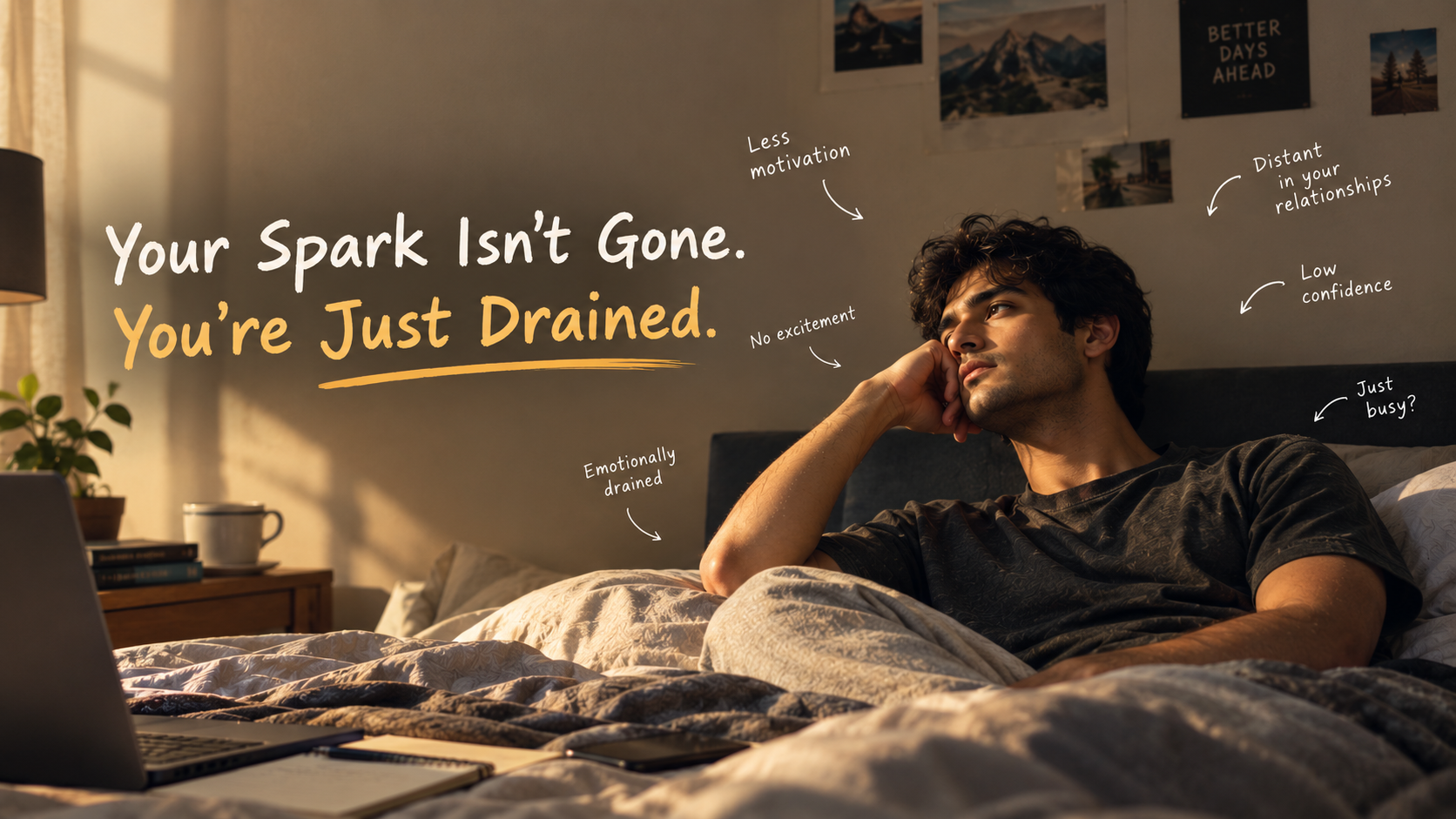
Rediscovering Your Spark After a Big Life Shift
New parent, newly single, new city, or just quietly not yourself lately — here's how confidence actually gets lost, and how it comes back.
Writer at Notty Talks. Curious about desire, intimacy, and what actually keeps people feeling like themselves.
Nobody loses their spark overnight.
That's the trick of it. There's no dramatic moment, no before-and-after photo. There's just a slow accumulation of small surrenders — the hobby you paused "for now," the friends you kept meaning to call, the mirror you stopped really looking into — until one ordinary day you catch your reflection in a shop window and think, with genuine surprise: when did I become someone who just... manages?
If you're there right now, this article is for you. And the first honest thing to say is that you didn't do anything wrong. Spark doesn't disappear because you're weak. It disappears because something big happened — and big things are expensive.
The shifts that take the most
Some life changes announce themselves as hard: a breakup, a divorce, losing someone, losing a job. Everyone around you expects those to knock you down, so at least you're allowed to wobble.
But some of the biggest confidence-eaters are the ones disguised as good news. A new baby — joyful, and also the single most identity-flattening event most people ever experience. A marriage, where your individual self quietly merges into a "we" and nobody tells you to keep a corner that's just yours. A big promotion that turns you into your job. A move to a new city where nobody knew the old, funnier you.
The pattern underneath all of them is the same: a big shift rewrites your daily life faster than it rewrites your identity. Your routines, your people, your mirrors — the thousand small surfaces that used to reflect you back at you — get swapped out. And without those reflections, your sense of self starts running on memory. Memory fades.
That's all "losing your spark" really is. Not a character flaw. A reflection shortage.
Why "just be confident" is useless advice
Here's what the confidence industry gets backwards. It treats confidence as a mood you can summon — stand tall, think positive, repeat affirmations into the mirror you've been avoiding.
But decades of psychology point the other way. Confidence is mostly evidence-based. Your brain is a fairly honest accountant: it believes what you show it. Researchers who study self-efficacy — the belief that you can handle things — find it's built overwhelmingly from one source: the experience of actually handling things. Small, real, repeated proof.
Which is genuinely good news, because it means the way back doesn't require feeling confident first. It requires collecting evidence first. The feeling is the lagging indicator, not the starting requirement.
It also explains why the spiral happens. After a big shift, you stop doing the things that generated proof — the sport, the craft, the socialising, the dressing-up-for-no-reason. Less proof, less confidence. Less confidence, less doing. Same spiral as any other, and it breaks the same way: not with a feeling, but with a move.
The way back, in small deposits
Forget transformation. Transformation is what got you exhausted. This is about deposits — small, almost embarrassingly small, and repeated.
Reclaim one abandoned thing. Not five. One. The guitar, the morning walk, the sketchbook, the Sunday football. Pick the one that was most yours — the one that had nothing to do with any role you play for other people — and give it thirty minutes this week. The point isn't the activity. The point is the message it sends the accountant: I still exist outside my duties.
Fix one mirror. By which we mean: one surface that reflects you accurately. Often it's a person — the friend who knew you before the shift, the one you keep meaning to call. Old friends are confidence infrastructure; they hold a version of you that current life has misplaced. Make the call. Awkward after eight months of silence? They've been meaning to call you too.
Tend the machine. There's no way around this part, so we'll say it plainly: sleep, movement, and daylight are not wellness clichés, they're the substrate confidence runs on. Nobody feels like themselves on six broken hours a night. You don't need a fitness plan — you need to stop treating your body like a rental. Start with sleep; everything else gets easier from there.
Dress for the person, not the errand. Small one, real one. After a big shift, most people's grooming and clothing quietly collapse to "functional." Reversing that — even slightly, even at home — is one of the fastest reflection-fixes available. Not for anyone else. For the shop window.
Say one true thing out loud. Confidence and honesty are cousins. Every time you say the true thing — "I'm actually struggling a bit," "I don't want to come on Sunday," "I'd like to be considered for that" — you teach yourself that your voice holds weight. People-pleasing feels safe and costs spark. Start small, but start.
What to expect (an honest timeline)
Week one, you'll feel slightly ridiculous. The guitar will sound bad. The walk will feel pointless. This is normal — evidence takes time to accumulate, and the accountant is sceptical at first. It has months of contrary bookkeeping to overturn.
Somewhere in weeks three to six, something small shifts. You'll catch yourself laughing at your own joke, or walking slightly faster, or looking forward to the thing. Don't announce it. Just keep depositing.
And be warned about the relapse day — everyone has one. The day the old flatness returns and you conclude none of it worked. It did work. Flat days are weather, not verdicts. Deposit anyway.
When it's heavier than a spark problem
Honesty clause: sometimes what feels like lost spark is something that deserves more than a comeback plan. If the flatness is constant rather than patchy — if nothing brings even brief enjoyment, if sleep and appetite have changed and stayed changed, if it's been months and the deposits aren't landing at all — talk to a doctor or a therapist. Not as a last resort; as a smart move. Low mood that persists is common, treatable, and absolutely not a character verdict. Getting help is the confident move.
The point of it all
Here's the reframe to keep: you're not trying to get the old you back. That person belonged to a life that no longer exists — and honestly, some of what you're grieving is just familiarity.
You're building the next version — someone who's been through the shift and kept a self on the other side of it. That version tends to be quieter than the old one, and sturdier. Spark 2.0 doesn't come from having never been dimmed. It comes from knowing, from experience, that you can relight it.
One deposit this week. That's the whole assignment.